
“We librarians flatter ourselves that we know a thing or two about organizing information. It’s time we stepped up and contributed to Wikipedia: not just to its content but to its structures and technologies. This project page is intended to provide a rallying point for these activities.”
Author Archives: ben vershbow
a big bang theory for media
Future generations, living comfortably as digital natives, may look back on the twentieth century as the big bang moment in the history of media. The big bang theory, by now a household concept in the annals of cosmology, speculates that the universe began some 13 or 14 billion years ago in a massive explosion of matter from an original, super-dense, super-heated singularity. 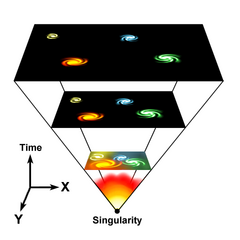 What does this have to do with twentieth century media? More than you might think. Industrialization and the development of telecommunications resulted in the centralization of communication forms into a kind of super-dense, super-heated singularity of their own: the mass media. Its power to drive a consumer economy through advertising, and blanket entire populations with messages and imagery has been so impressive, so all-consuming, that in a very short time it has come to seem all but inevitable.
But much to mass media’s surprise (and horror), the singularity has exploded. With the web barely a decade old, it looks like the reign of mass media is turning out to have been only a brief interlude between a pre-electrified world, and a vastly uncertain digital horizon. Generations for whom radio and television were wondrous novelties assumed a passive posture, letting the transmission waves wash over them. But subsequent ages, reared in the super-heated forge of the mass media, have grown increasingly impatient with the paleolithic norms of the TV network, the daily newspaper, the cineplex, and the publishing conglomerate. They want more diversity, more choice, more mobility, and more opportunity to contribute in the very forms the media taught them. Totally decentralized, the internet is a different kind of animal, and since it can absorb and copy basically any kind of media, it is perceived by Big Media as fundamentally hostile to its interests. Consequently, they are doing everything in their power to preserve the models that worked so well for them when the universe was still young and galaxies (chains, affiliates, imprints) were still within their grasp: suing file-sharing services, going after DVD pirates, and slapping all sorts of nasty DRM (digital rights management) on the little downloadable content they are tentatively trying to sell. But in the end, it’s a losing battle. Trying to hold still in a swiftly expanding cosmos will prove at first uncomfortable (as it is now) and eventually impossible. The universe is moving outward. Later, we’ll tell our grandchildren what it was like to watch the big bang and the brief, brilliant age of the mass media.
The Wall Street Journal ran a free web feature today – “How Old Media Can Survive In a New World” – examining the crisis facing mass media, asking influential observers in each industry what might be done to adapt to the decentralized laws of the web and how to profit from media that has no physical dimension. It serves as a nice snapshot of the explosion in its current phase.
web marginalia
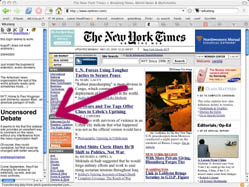 About a week ago, I attended a fascinating workshop at USC on Social Software in the Academy – a gathering of some of the most interesting thinkers, teachers and innovators at the intersection of technology and education. I learned a great deal, much of which I’m still processing and will be posting about this week. I also found out about some exciting new tools. One of them is Wikalong, a plugin for the Firefox browser. Wikalong makes it possible to write notes in the margin of a web page (something we take for granted in paper books). Reviews, rebuttals, conversations, subversive commentary, a “roving weblog,” or just plain old notes – all of these are possible in the little sidebar wiki notebook that Wikalong places to the left of any web page you go to. Online reading enhanced.
A great part of history is written in the marginalia, and I suspect that networked marginalia is territory worth exploring. Wikalong might be just a literal-minded stepping stone to more interesting forms, but the profundity of the margin (which lies in its spacial relationship to the primary text) shouldn’t be underestimated. 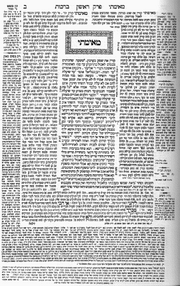 Sparks fly between juxtaposed texts. While hyperlinks enable the reader to leap between textual worlds, they suck you down a wormhole to a distant place. Sometimes it’s better to be in both spaces at the same time (like keeping two browser windows open at once). Think of the Talmud, the great Jewish compendium of law and exegesis. On each page, commentaries are arrayed around a core text. Wikalong may seem insignificant next to this ancient hypertext system, but it points to a related sort of spatial intertextuality that should theoretically be possible in the new medium. If a flat page can be so multi-dimensional, think of how far we might be able to go in a virtual space.
Another handy tool is PurpleSlurple, which provides granular addressability for any existing web page. In other words, it inserts links for paragraphs and headers, allowing you to reference specific sections of text on a given page. Each “slurped” page gets its own URL, as does each individual element that has been anchored with a reference number. It’s primitive, but could come in extremely handy. For bloggers, this provides another way to reference a particular passage in a long web document. Just slurp the page, then link to the specific section.
Nils Peterson, of Washington State University, presented these tools, along with del.icio.us and a visualization application from Tufts called VUE, as a “juxtaposition of technologies” – a toolkit enabling a web reader or writer to more effectively annotate, reference and quote within the web.
“ubiquitous social encyclopedia”
Cellphedia, a thesis project at the Interactive Telecommunications Program at NYU, is a user-generated encyclopedia composed of text message Q&A from cell phones – a kind of mobile, hyper-abbreviated Wikipedia. But unlike Wikipedia, Cellphedia entries are not open to editing by the community, at least not yet. Inspired by Dodgeball, a popular friend-tracking service, Cellphedia suggests something more along the lines of a massive, multi-user trivia game than a serious knowledge resource. It’s the kind of street research that is becoming more common. Answers on impulse. The web overlayed on the physical world.
mobile web initiative
The World Wide Web Consortium (W3C), the main standards-setting body for the networked world we live and breathe, recently launched the Mobile Web Initiative. From the press release:
“Many of today’s mobile devices already feature Web browsers and the demand for mobile devices continues to grow. Despite these trends, browsing the Web from a mobile device — for example, to find product information, consult timetables, check email, transfer money — has not become as convenient as expected. Users often find that their favorite Web sites are not accessible or not as easy to use on their mobile phone as on their desktop computer. Content providers have difficulties building Web sites that work well on all types and configurations of mobile phones offering Web access.”
The web is moving further and further from being exclusively a desktop system. What began essentially as a set of interlinked brochures, to be read sitting down, has evolved into a dynamic, social multimedia space, increasingly connected to the world around us. I often think of the history of industrialization as a story of estrangement from the physical world. Cities swell, smog billows and the haze of electric light washes out the stars. Mass media forms naturally emerge from the concentration of industry – economies of scale that favor homogeneity, the sweeping gesture. At first, the new media seem to take this estrangement further, confining us to “virtual” spaces. But quite to the contrary, the web is taking us back into the world, not out of it. Even something as simple as Google Maps suggests this return. But to become fully unmoored from our desks, standards have to be set in place to ensure that the web is readable in smaller formats, and that we have faster, more reliable access when we’re on the move. Plus, the devices need to emerge that offer the convenience of a cell phone with the power of a notebook computer. The future of personal computing lies more with cell phones (see the new Sidekick II), iPods and Play Station Portable than with the latest desktop from Dell or Apple.
brush up your shakespeare
In Wired yesterday, Cory Doctorow sums up recent brave efforts by the BBC to adapt to a changing world: BBC Backstage, the Creative Archive, and reader-contributed photos.
“America’s entertainment industry is committing slow, spectacular suicide, while one of Europe’s biggest broadcasters — the BBC — is rushing headlong to the future, embracing innovation rather than fighting it. Unlike Hollywood, the BBC is eager and willing to work with a burgeoning group of content providers whose interests are aligned with its own: its audience.”
Above is a clip from a 1913 silent film version of Hamlet, downloadable for free from the British Film Institute under the aegis of the Creative Archive – one of the few bits of free content made available so far. It feels good to make a video quotation with total impunity. Perhaps others will be inspired to take a page from BBC’s book.
Here also is Rick Prelinger‘s speech to the Creative Archive Seminar in April. Prelinger is one of America’s great activist archivists.
NY Times chipping away at free content
Starting in September, the NY Times will charge an annual subscription fee for a “Select” service, including editorials, op-eds, and archives. Basic news content will remain free. Times chair Arthur Sulzberger Jr remarked that though online advertising is undergoing exponential growth, it is just a matter of time until it flattens out and assumes regular cycles, like in print advertising. Is the free content joyride gradually coming to an end? Or is the Times pounding nails into its own coffin?
“transliteracies” conference
“How are people today “reading” in digital, networked environments? For example, what is the relation between reading and browsing, or searching? Or between reading and multimedia? Can innovations in technologies or interfaces increase the productivity, variety, and pleasure of these new kinds of reading? How can the historical diversity of human reading practices help us gauge the robustness of the new digital practices; and, inversely, how can contemporary practices provide new ways to understand the technical, social, and cultural dimensions of historical reading?”
June 17-18 at UC Santa Barbara, kicking off the Transliteracies Project: “Research in the Technological, Social, and Cultural Practices of Online Reading”.
(thanks, Grand Text Auto)
incredible shrinking newspaper
Facing slipping circulation and massive migration to the web by younger news consumers, a number of top tier newspapers are switching from the traditional broadsheet format to the more handy tabloid, including the European and Asian editions of the Wall Street Journal.
But is this enough? One British advertiser remarks: “We want newspapers to come up with a solution to the threat of marginalization in a digitalized world. But they have to do more than just play around with the size of paper they’re printed on.”
The International Herald Tribune ran this story yesterday. I’ve plugged it before, but the IHT is noteworthy as one of the few online newspapers to eschew vertical scrolling for the layout of articles. Instead, they have simple, attractive (and I would argue, much more readable) horizontal scrolling across fixed, three-column plates. With its long vertical fields, you might say that web news, too, is stuck in the broadsheet model. The problem is that, unlike a print newspaper, a computer screen can’t be folded to improve readability, or to isolate a desired area of the page.
libraries improve the front end
 There’s a nice article in yesterday’s NY Times on how some university libraries are rethinking how they arrange their space – moving, or redistributing print collections to make way for an “electronic information commons.” It’s not about abandoning the books, or relegating them to a lesser status. It’s more about re-positioning them as a sort of physical database. If a library is a big computer, than the database exists toward the back end. These days, digging through the stacks, even if it results in a paper return, is generally done digitally. That’s the front end, or the interface, and this is what smart libraries are seeking to improve. Research and scholarly production may be going digital, but the social, conversational space of the university, and in turn, the library, is still vital. The strategy for the libraries, then, is to restructure and expand that space as a compelling social software environment – one that is both physical and virtual. Sounds good in theory, but I’m not sure that’s how these facilities will actually be used. Turning libraries into a hi-tech rec center might be sacrificing more than it saves.
The article focuses on reorganization efforts at the University of Texas at Austin. Press release here concerning the transformation of the Flawn Academic Center (likely a more durable link than the Times story).
(image: Perry-Castañeda Library at UT Austin)