

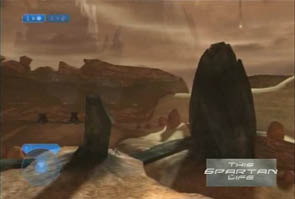
Following Bob’s foray into game space, experimental filmmaker Peggy Ahwesh takes the plunge in the second interview on “This Spartan Life,” a new talk show filmed in the world of the “Halo” video game series. In 2001, Ahwesh made a Machinima film of her own called “She Puppet” (Machinima is cinema made inside a game engine) using footage culled from months playing the “Lara Croft: Tomb Raider” game. So it doesn’t take long for her to feel right at home. This latest interview takes us through some truly spectacular landscapes and “fantasy architecture,” and, of course, features the customary random bursts of violence (not to mention teleportation and a little skull-dribbling).
I think the Spartan Life folks have a good concept here. The conversations are interesting, but what makes them even more compelling is the fact that an exploration is taking place. It’s like walking around in an abandoned film set. Much of it is tongue-in-cheek. “Sometimes you really feel like you’re running through this insane maze, and somebody’s always scoping in on you,” says host Damian Lacedaemion, his helmeted head framed in someone’s crosshairs. “There’s this constant threat of violence hanging in the air around here.” But there’s an element of genuine wonder as well. Two strangers explore a bizarre new world, a world normally governed by rules and a quest. But they are simply rovers, and there is no quest. There is only curiosity and play. As Damian says: “sometimes I think it feels like being in a movie that’s waiting for you to set it in motion.”
Author Archives: ben vershbow
web pubs will become more like cable
In Wired, “Web Publishers Eye Your Wallet,” Adam L. Penenberg chats with Pat Kenealy, CEO of International Data Group (IDG), which publishes over 300 computer, game, and info tech-related magazines. Kenealy thinks it’s only a matter of time before premium web publications start raising their gates and asking for money. The conventional wisdom is that charging for content, or even asking readers to register, is suicide. But Kenealy points to cable television for evidence that people can get used to paying for something they really want:
“In 1955, TV was free,” Kenealy said, “and two generations later most people pay for it. There was a built-in reluctance to pay for TV until it got so much better than broadcast. That’s what I think will happen with the internet.”
With cable, one monthly fee gets you access to hundreds of channels. You don’t have to fill out dozens of subscriptions to dozens of different stations. Except for premium channels, everything is more or less set. Web publishers need to figure out a similar system. KeepMedia is a site that is experimenting with this. I would bet that eventually cable will merge with the web into one standard service: basic cable/web over broadband. Your premium channels (sites?) – in addition to HBO and Showtime – might be The New York Times, The Economist and The Atlantic, while basic cable/web would include Discovery, Comedy Central, MTV, ESPN etc., along with Forbes, Wired, Knight Ridder and Tribune newspapers, Reuters and hundreds, even thousands, more. A few of the more popular blogs might be thrown in there too. There will always be the free web too, just as there’s free television and radio, but I agree with Kenealy that we’re going to see a migration of many web publications toward a cable-style model.
See also, “web news as gated community” on this blog.
the librarian in the techno-spa
 The uncritical embrace of technology plagues American universities and consumers alike, whose credo is “adopt first, ask questions later.” An assistant professor of english from an unnamed Midwestern liberal arts college, writes in the Chronicle of Higher Education of his dismay at the changes underway in American university libraries, where traditional stacks are left to deteriorate while money is lavished on fancy “techno-spas,” transforming research sanctuaries into digital rec centers. The article is written in response to a very a real trend, brought to wider public attention in a NY Times article in May about an initiative at the University of Texas, Austin library in which approximately 90,000 books are to be relocated from the Flawn Academic Center to other libraries around campus to make way for a “24-hour information commons.”
Benton’s rhapsodizing on the pleasures of the stacks can be trying:
I once had a useful, relevant book fall on my head like Newton’s apple. Perhaps it was pushed there by some ghostly scholar, one of my forebears whom I might consider myself privileged to join in the posthumous academy of spectral stack walkers.
But his overall criticism is correct. Many universities have adopted a servile stance, catering to what they perceive to be a new breed of restless, multi-tasking student. But the “customer is always right” philosophy probably isn’t doing the students any favors in the long run. A generation is coming of age lost somewhere between the old print-based hierarchies of knowledge and the new Googlesque. And they aren’t receiving much in the way of guidance. A university president needs shiny groves of sleek new computers to wow the funders and alumnae, just as he needs a winning football team. The business of universities and the business of technology march ahead together without much thought for what kind of citizen they might be producing.
From Benton:
Library administrators have had to make hard choices as costs have risen, their missions have expanded, and their budgets have failed to keep pace. But I am not so sure that the techno-spa model should be adopted so uncritically. Who will profit most from the transformation now and in the future, as fees and updates for new technologies continue indefinitely? Is that transformation really about the demands of students? If so, should we conform to their expectations, or make an effort to reshape them against the grain of the culture?
Alas, at many institutions, there is no longer much room for books on our central campuses. But we do have room for coffee bars, sports facilities, and a collection of other expensive, space-consuming amenities.
For that reason, I find it hard to accept that digitization is motivated primarily by constrained budgets and limited space. The money is there, and so is the space. It’s just that colleges want to spend the money and use the space for something else that, presumably, will make them more competitive among students who are, perhaps, more interested in amenities than education.
One purpose of universities is to provide insulation from the world at large for the cultivation of sensitive minds. Universities might consider extending this principle to technology, applying the brakes on what could be a runaway train. The Amish, who, to say the least, are loathe to adopt new technologies, ask first, when confronted with a new invention, how it might change them. We could learn something from that. The answer isn’t to hold candlelight vigils for the death of the card catalogue or the scribbled margin note, but rather to ask at each step how this is changing us, and whether we think it is a good thing.
(image by kendrak, via Flickr)
if you love your book, set it free
A piece in the Wall Street Journal a few days ago explores how some publishers and authors are trying to use the web to promote books. One way is to offer free electronic copies – of a whole book, in the case of sci-fi writer and Boing Boingian Cory Doctorow, or sometimes just a chunk to the get the reader hooked, as was the case with Murakami’s “Kafka on the Shore,” the first five chapters of which Knopf put online for free. Some publishers are courting bloggers, sending free copies, seeking endorsements, facilitating author interviews. Some are setting up blogs of their own (see the Freakonomics blog). There are currently two fan sites devoted to a fictional actress appearing in Bret Easton Ellis’s forthcoming novel “Lunar Park.”
publishers fire another volley at google library
 Last week, the Association for Learned and Professional Society Publishers (ALPSP) joined the escalating chorus of concern over the legality of Google’s library project, echoing a letter from the Association of American University Presses in May warning that by digitizing library collections without the consent of publishers, Google was about to perpetrate a massive violation of copyright law. The library project has been a troublesome issue for the search king ever since it was announced last December. Resistance first came from across the Atlantic where French outrage led a unified European response to Google’s perceived anglo-imperialism, resulting in plans to establish a European digital library. More recently, it has come from the anglos themselves, namely publishers, who, in the case of the ALPSP, “absolutely dispute” Google’s claim that the project falls within the “fair use” section of the US Copyright Act. From the ALPSP statement (download PDF):
The Association of Learned and Professional Society Publishers calls on Google to cease unlicensed digitisation of copyright materials with immediate effect, and to enter into urgent discussions with representatives of the publishing industry in order to arrive at an appropriate licensing solution for ‘Google Print for Libraries’. We cannot believe that a business which prides itself on its cooperation with publishers could seriously wish to build part of its business on a basis of copyright infringement.
In the relatively brief history of intellectual property, libraries have functioned as a fair use zone – a haven for the cultivation of minds, insulated from the marketplace of ideas. As the web breaks down boundaries separating readers from remote collections, with Google stepping in as chief wrecking ball, the idea of fair use is being severely tested.
television merging with the web
With faster and faster broadband connections, it’s getting easier to deliver video content over the internet, blurring the lines between television and the web. More and more, we’re living in that blur, and a few recent changes suggest that the trend toward convergence is inevitable. CBS News, though lagging behind its competitors today, seems to get the message that tightly scheduled, broadcast media will soon be a relic of the past. In a bid to stay ahead of the curve (and perhaps, in time, of the competition), CBS News has totally revamped its website into what it calls a “24-hour, on-demand news service, available across many platforms.” There you will find a variety of interactive features, text news from the wires, live radio, RSS feeds, and a podcasting service. You will also find dozens upon dozens of free video segments – the usual television programming, only broken up into bight-sized chunks. From these clips, visitors are invited to “build a newscast,” assembling video segments into a personal playlist. Sooner or later, when other news outlets go the same way, we’ll begin to see RSS video aggregators that automatically pull clips from around the web, the same way feed readers assemble text news today. This is already beginning to happen for video blogs.
But it’s not just the crusty old news networks that are changing. With AOL’s webcast of the the Live 8 concerts, and Amazon’s upcoming 10th Anniversary shindig, where it will be streaming live on its site a concert featuring Bob Dylan and Norah Jones, it seems the TV-web merger is being driven from both sides.
Article: “TV Moves to the Internet”
vimeo open to the public – new constellations in the sky
In February, I stumbled upon a wonderful new site for storing and sharing video clips, which, until recently, was being tested on closed beta. Now fully open to the public, Vimeo aims to do for short form video what Flickr does for photos, openly citing the photo-sharing phenom as inspiration. Right now, it’s pretty basic. Create a free account and you can start uploading compressed clips (8MB weekly limit), adding tags, and browsing what other users have put up. Over time, I expect they’ll start adding some Flickr-esque features (like in-house email, groups, video sets, calendar, favorites and who knows what else). When Vimeo first came onto my radar, they had an interesting feature that allowed you to string several clips together within a single tag, creating an ad hoc montage. They still say on their “about” page that “several clips can be played together to create a movie,” but I could no longer figure out how to do that.
All in all, given how troublesome it can be to get video working on the web, Vimeo seems to be off to a very smooth start. Something I hope they figure out is how to make it easy for users to post video to blogs. If they could rig up a basic form that automatically embeds a clip into a blog post, it would be a tremendous boon to the incipient video blogging community. And if they could provide basic video editing tools, then they might have something really big on their hands. (I’ve posted here my inaugural upload to Vimeo – a column from the ruins at Caesaria, from my recent trip to Israel.)
Though just barely off the ground, I have a feeling that Vimeo could evolve into something serious. Another exciting launch is Odeo, the podcast hub. Taken together as a constellation, these three ventures – Flickr, Vimeo, and Odeo – are constructing the beginnings of a vast media commons, tiny when compared with the giant 20th century media industries, but maybe not for long (see post on the London bombings). Another recently launched site, ourmedia, seeks to create a similar kind of homebrew media repository, offering (through a partnership with the Internet Archive) to “host your media forever — for free.” But so far, I’ve been much more impressed with the the afore-mentioned image/video/sound trio. Different media present different challenges, and there’s something to be said for doing one thing really well rather than trying to do everything sort of well. I’ve found ourmedia’s interface frustrating. It’s difficult to browse for media, and sometimes hard to open an item once you’ve found it. Flickr, Vimeo and Odeo all provide a dynamic tagging system, making it much easier for users to dig and explore. ourmedia has no such system. What ourmedia is exploring more intensively (and Odeo too) is the need for an editorial voice, maintaining a rotating roster of volunteer editors, whose duties, among other things, include constructing the site’s homepage. Odeo, on the other hand, is more clearly descended from traditional broadcast media, namely radio. The site is organized into channels, each with its own signature mix of programming. But unlike a radio station, an Odeo channel has fluid boundaries. Listener’s can pick and choose programs, constructing their own broadcast.
But ultimately, we can’t leave it up to these sites to make selections for us. Flickr has its own blog where the site’s creators draw attention to noteworthy material. But more interesting is Flickrzen, a blog posting regular “reportages” of the most compelling photos turning up on Flickr. Flickr Pix Photo Magazine is on a similar mission. Of course, with millions of photographs already on Flickr, and thousands pouring in as I write, it would be impossible for any single editorial body to exhaustively survey the whole repository. So there’s definitely room for more of these curatorial ventures. They are the next step.
curvaceous electronic paper, with color


Fujitsu has developed a flexible, light-weight electronic display capable of retaining stable, full-color images even when bent. About as thick as a plastic transparency (like an x-ray), the paper consists of three substrate layers (red, green and blue) and requires “only one one-hundredth to one ten-thousandth the energy of conventional display technologies.” The paper’s memory system enables continuous image display with zero energy required, while changing images consumes only a negligible amount of power. And because displays won’t require continuous updates, Fujitsu boasts, the screen will not flicker. The paper should be available to consumers by Spring, 2006. It will be pushed for use in the office, home and for signs and advertisements in public spaces. It’s not clear, however, if it will be able to handle film or sophisticated animation (I would guess not very well). If anyone reading this happens to be in Tokyo today or tomorrow, the prototype is currently being exhibited at the Fujitsu Forum.
the tipping point for citizen journalism?
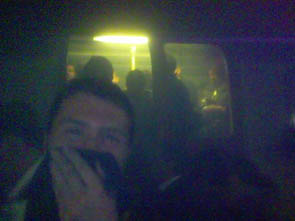
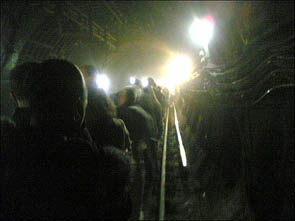
We are fast approaching a point when there will be as many cameras as there are points of view. Everyone is an eye with a record button – embedded, as it were, in the trenches of everyday life. In the week that has passed since the bombs rocked London, major newspapers and television networks have run images and grainy video clips captured by ordinary people on their cellphones and digital cameras. Flickr has become a clearinghouse for July 7 terror blast images. Technorati has tracked the commentary and condolences that have flowed through the blogosphere. The Wikipedia community has mounted a detailed page, through thousands of edits, that combines the most up-to-date developments of the news with the useful contextual evidence and historical background that one would expect from an encyclopedia. But it’s the images and video that have made the greatest penetration into the mainstream media. From “London Bombing Pictures Mark New Role for Camera Phones” in National Geographic News:
The BBC said it received around 30 video clips from members of the public and more than 300 e-mails containing an average of three images each on the day of the attacks. TV news channels, meanwhile, aired cell phone video footage within half an hour of the explosions.
These are probably the two most reproduced images:
From a column in Digital Journalist on “citizen shutterbugs”:
Many times these images are sent to family members first and then later find their way into the river of data that becomes public information. At times, some of these images are “picked up” by the mainstream media and disseminated as “real” news, which of course they can be.
The same goes for the photos from Abu Ghraib, first distributed among friends as perverse trophies from the land of occupation. I wonder about this impulse to record one’s life in such fine-grained detail – it seems the new technologies turn us into auto-voyeurs. The soldiers record their crimes and end up implicating themselves. Similarly, the victims of the London bombings record their evacuation march through the tunnels, bearing witness to their own trauma. Then there are the onlookers, the passersby, who happen to be near the chaos.
Were the London bombings the tipping point? A local news cameraman meditates on the imminent decline of his profession:
Now, a new revolution is about to be televised. Tiny lenses are popping in the most unlikely of devices, powerful editing is just a laptop away and personal websites are racing towards critical mass. How long before my oversized fancy-cam looks like an early 80’s bag phone? About the same time the six o clock news begins looking like it was shot by a hopped-up junkie with a twitchy digital, I’m guessing. The next ten years promise to feature a rapid breakdown of my chosen craft. Whatever new paradigm takes hold, it’s a safe bet the two-person news crew is an endangered species, driven to oblivion by technology and methods that are faster and cheaper, but not necessarily better. Hopefully by that time, I’ll have found more fulfilling ways to make a difference and a paycheck. Until then, I’ll be here in the media pack, one eye buried in a viewfinder, the other one keeping steady watch over a nation of digital interlopers.
Other relevant items:
From Newsweek: “History’s New First Draft”
From the BBC: “Mobiles Capture Blast Aftermath”
walking around inside a book – bob’s interview in halo space
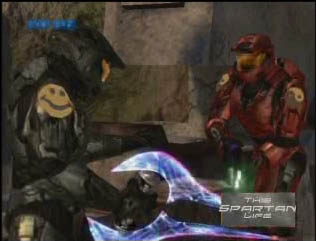 A couple of months ago, Bob did a rather unusual interview for This Spartan Life, a new online talk show set in the world of Halo video game series. I just received word that the first episode is now up. The show is hosted by Damian Lacedaemion, a hulking, bionic warrior sporting a thousand pounds of body armor, a visored helmet, and what looks like an enormous, ion-charged hair clip. Ordinarily, this character would be blazing his way through an interplanetary battle zone, but here, he’s chatting it up with Bob (also represented by a fearsome armor-plated commando) about the future of books. The effect is truly bizarre.
The show was taped in a studio, with Bob and Damian (played by director Chris Burke), controllers in hand, seated in front of an Xbox console. Totally abandoning the story line of the game, the two avatars move through the surreal landscape – part derelict Soviet steel mill, part remote desert island – as though simply going for a stroll in the park. All their meanderings are recorded through a video feed and edited later on. Periodically, the conversation is interrupted by unfriendly fire from other online gamers unaware that a more civil interaction is taking place in the forbidding combat terrain. Damian has to deal with these intrusions, casually lobbing a grenade mid-sentence, or swooping across several hundred yards of game space to decapitate an assailant, swooping back to catch the end of Bob’s remark. It’s quite entertaining: the incongruousness of the conversation within the alien landscape of the game, the sudden bursts of violence. It reminds me a bit of Space Ghost Coast to Coast, which turned an old Hanna Barbera cartoon character into a talk show host with real celebrity guests. In the case of Spartan Life, there’s something weirdly logical about placing a conceptual conversation about the future in the future. A nice expressionistic touch.
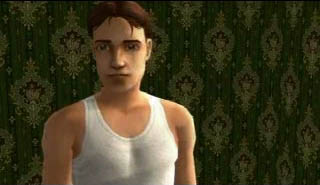 The show fits into a recently emerged genre of films set in video game environments, known as “Machinima.” Most of the Machinima films I’ve seen are best described as surreal sitcoms – short episodes commenting on the inherent strangeness of video game worlds. The characters are often in the midst of existential crisis, asking “what am I doing here?” Like certain other genres (say, musicals), video games can appear comically absurd by adding just a small dose of reality. So far, Machinima has played in this territory, floating banal chit chat into the hyper-violent game worlds, finding humor in juxtaposition. Other games, like the Sims, offer their own possibilities for comical remixing. It’ll be interesting to see if the genre matures beyond this. By conducting real interviews, often with people unfamiliar with the game environment, This Spartan Life introduces a nice element of surprise.
It’s hard for us more traditional readers to grapple with the significance of video games. During the interview, Bob muses about what it will be like to walk around inside a book. What if other readers are interrupting or joining in the story you are reading? I grew up playing linear 2-D games like Super Mario Bros. and Castlevania. By the time the next generation of game systems was hitting the market with their new immersive 3-D narratives, my gaming habit had tapered off. But increasingly, kids are growing up with the expectation that narrative worlds (like books) will be interactive, multidirectional, and almost hallucinogenically real. There is the familiar complaint that younger generations have short attention spans, but the evidence offered by gaming suggests the opposite. While many kids may indeed have short attention spans for traditional media like books and certain kinds of films, they are perfectly capable of spending long stretches of time in complex game environments that combine stories with problem and puzzle solving, and that allow them to engage with peers within the game space. This is territory explored by Steven Johnson’s new book, which I have yet to pick up. But I’ll end with an amusing quote from his blog that I posted back in April when the book was coming out. It imagines what might have been society’s response if video games were in fact the older invention and books the dangerous new toy.
Reading books chronically under-stimulates the senses. Unlike the longstanding tradition of gameplaying–which engages the child in a vivid, three-dimensional world filled with moving images and musical soundscapes, navigated and controlled with complex muscular movements–books are simply a barren string of words on the page. Only a small portion of the brain devoted to processing written language is activated during reading, while games engage the full range of the sensory and motor cortices.
Books are also tragically isolating. While games have for many years engaged the young in complex social relationships with their peers, building and exploring worlds together, books force the child to sequester him or herself in a quiet space, shut off from interaction with other children. These new ‘libraries’ that have arisen in recent years to facilitate reading activities are a frightening sight: dozens of young children, normally so vivacious and socially interactive, sitting alone in cubicles, reading silently, oblivious to their peers.
Many children enjoy reading books, of course, and no doubt some of the flights of fancy conveyed by reading have their escapist merits. But for a sizable percentage of the population, books are downright discriminatory. The reading craze of recent years cruelly taunts the 10 million Americans who suffer from dyslexia–a condition didn’t even exist as a condition until printed text came along to stigmatize its sufferers.
But perhaps the most dangerous property of these books is the fact that they follow a fixed linear path. You can’t control their narratives in any fashion–you simply sit back and have the story dictated to you. For those of us raised on interactive narratives, this property may seem astonishing. Why would anyone want to embark on an adventure utterly choreographed by another person? But today’s generation embarks on such adventures millions of times a day. This risks instilling a general passivity in our children, making them feel as though they’re powerless to change their circumstances. Reading is not an active, participatory process; it’s a submissive one. The book readers of the younger generation are learning to ‘follow the plot’ instead of learning to lead.