
An editorial in today’s New York Times by The Search author Jon Battelle makes the argument that the current resurgence in technology stocks is not the sign of another technology “bubble,” but rather an indication that companies have finally figured out how to capitalize on the internet. Batelle writes:
… we are witnessing the Web’s second coming, and it’s even got a name, “Web 2.0” – although exactly what that moniker stands for is the topic of debate in the technology industry. For most it signifies a new way of starting and running companies – with less capital, more focus on the customer and a far more open business model when it comes to working with others. Archetypal Web 2.0 companies include Flickr, a photo sharing site; Bloglines, a blog reading service; and MySpace, a music and social networking site.
In other words, Batelle is pointing out that one way to “get it right” is not to sell content to users, but rather to give them the opportunity to create and search their own content. This is not only good business sense, he says, it’s also more enlightened — the creators of social software such as Flickr are motivated equally by a desire to “do good in the world” and a desire to make money. “The culture of Web 2.0 is, in fact, decidedly missionary,” Batelle writes, “from the communitarian ethos of Craigslist to Google’s informal motto, ‘don’t be evil.'”
O.K. Doing good while making money. Reading this, I’m reminded of Paul Hawken’s Natural Capitalism and the larger sustainability movement — the optimistic philosophy that weaves together environmental ethics and profitability. But is that what’s really going on here? Isn’t the “missionary” culture of the internet a bit OLDER than Web 2.0? Batelle is suggesting that Internet capitalists have gotten all misty and utopian; isn’t it the case that some of the folks who were already misty and utopian have just started making some money?
I guess the more viable comparison here would be to Marc Andreessen’s decision to transform his Mosaic browser from its public-domain University of Illinois incarnation into the Netscape Browser. Andreessen certainly started out as a browser missionary — and, like the companies Batelle sees as characteristic of Internet 2.0, Andreessen’s vision for Netscape (and in the beginning, Jim Clark’s vision as well) was a strong customer focus and open business model. What happened? Netscape’s meteoric success helped inflate the internet “bubble” Batelle’s referring to, and in the end, after the long battle with Microsoft, the company’s misfortunes helped to burst that bubble as well.
So what paradigm fits? Is “Internet 2.0” really new and more socially enlightened? Or are we just seeing a group of social software businesses — and one big search engine — just in the early stages of an inevitable transformation into corporations that are less interested in doing good than making money?
Incidentally, last month, Marc Andressen launched a social networking platform called Ning.
Yearly Archives: 2005
google print is no more
Not the program, of course, just the name. From now on it is to be known as Google Book Search. “Print” obviously struck a little too close to home with publishers and authors. On the company blog, they explain the shift in emphasis:
No, we don’t think that this new name will change what some folks think about this program. But we do believe it will help a lot of people understand better what we’re doing. We want to make all the world’s books discoverable and searchable online, and we hope this new name will help keep everyone focused on that important goal.
blogging and the true spirit of peer review
Slate goes to college this week with a series of articles on higher education in America, among them a good piece by Robert S. Boynton that makes the case for academic blogging:
“…academic blogging represents the fruition, not a betrayal, of the university’s ideals. One might argue that blogging is in fact the very embodiment of what the political philosopher Michael Oakshott once called “The Conversation of Mankind”–an endless, thoroughly democratic dialogue about the best ideas and artifacts of our culture.
…might blogging be subversive precisely because it makes real the very vision of intellectual life that the university has never managed to achieve?”
The idea of blogging as a kind of service or outreach is just beginning (maybe) to gain traction. But what about blogging as scholarship? Most professor-bloggers I’ve spoken with consider blogging an invaluable tool for working through ideas, for facilitating exchange within and across disciplines. Some go so far as to say that it’s redefined their lives as academics. But don’t count on tenure committees to feel the same. Blogging is vaporous, they’ll inevitably point out. Not edited, mixing the personal and the professional. How can you maintain standards and the appropriate barriers to entry? Traditionally, peer review has served this gatekeeping function, but can there be a peer review system for blogs? And if so, would we want one?
Boynton has a few ideas about how something like this could work (we’re also wrestling with these questions on our back porch blog, Sidebar, with the eventual aim of making some sort of formal proposal). Whatever the technicalities, the approach should be to establish a middle path, something like peer review, but not a literal transposition. Some way to gauge and recognize the intellectual rigor of academic blogs without compromising their refreshing immediacy and individuality — without crashing the party as it were.
There’s already a sort of peer review going on among blog carnivals, the periodicals of the blogosphere. Carnivals are rotating showcases of exemplary blog writing in specific disciplines — history, philosophy, science, education, and many, many more, some quite eccentric. Like blogs, carnivals suffer from an unfortunate coinage. But even with a snootier name — blog symposiums maybe — you would never in a million years confuse them with an official-looking peer review journal. Yet the carnivals practice peer review in its most essential form: the gathering of one’s fellows (in this case academics and non-scholar enthusiasts alike) to collectively evaluate (ok, perhaps “savor” is more appropriate) a range of intellectual labors in a given area. Boynton:
In the end, peer review is just that: review by one’s peers. Any particular system should be judged by its efficiency and efficacy, and not by the perceived prestige of the publication in which the work appears.
If anything, blog-influenced practices like these might reclaim for intellectuals the true spirit of peer review, which, as Harvard University Press editor Lindsay Waters has argued, has been all but outsourced to prestigious university presses and journals. Experimenting with open-source methods of judgment–whether of straight scholarship or academic blogs–might actually revitalize academic writing.
It’s unfortunate that the accepted avenues of academic publishing — peer-reviewed journals and monographs — purchase prestige and job security usually at the expense of readership. It suggests an institutional bias in the academy against public intellectualism and in favor of kind of monastic seclusion (no doubt part of the legacy of this last great medieval institution). Nowhere is this more apparent than in the language of academic writing: opaque, convoluted, studded with jargon, its remoteness from ordinary human speech the surest sign of the author’s membership in the academic elite.
This crisis of clarity is paired with a crisis of opportunity, as severe financial pressures on university presses are reducing the number of options for professors to get published in the approved ways. What’s needed is an alternative outlet alongside traditional scholarly publishing, something between a casual, off-the-cuff web diary and a polished academic journal. Carnivals probably aren’t the solution, but something descended from them might well be.
It will be to the benefit of society if blogging can be claimed, sharpened and leveraged as a recognized scholarly practice, a way to merge the academy with the traffic of the real world. The university shouldn’t keep its talents locked up within a faltering publishing system that narrows rather than expands their scope. That’s not to say professors shouldn’t keep writing papers, books and monographs, shouldn’t continue to deepen the well of knowledge. On the contrary, blogging should be viewed only as a complement to research and teaching, not a replacement. But as such, it has the potential to breathe new life into the scholarly enterprise as a whole, just as Boynton describes.
Things move quickly — too quickly — in the media-saturated society. To remain vital, the academy needs to stick its neck out into the current, with the confidence that it won’t be swept away. What’s theory, after all, without practice? It’s always been publish or perish inside the academy, but these days on the outside, it’s more about self-publish. A small but growing group of academics have grasped this and are now in the process of inventing the future of their profession.
the fly — a hundred dollar “pentop” for the overdeveloped world
 Two products that will most likely never be owned by the same teenager: The hundred dollar Laptop from MIT and the hundred dollar “pentop” computerized pen called the Fly. While the hundred dollar laptop (as we’ve said a few times on this site already) is promoted as a device to bring children of underdeveloped countries into the silicon era, the Fly is a device that will help technology-saturated 8 to 14 year olds keep track of soccer practice, learn to read, and solve arithmetic equations. Equipped with a microphone and OCR software, the Fly will read aloud what you write: if you use the special paper that comes with the product, you can draw a calculator and the calculator becomes functional. It’s all very Harold and the Purple Crayon .
In his review of the Fly’s capabilities in todays New York Times, David Pogue is largely enthusiastic about the device, finding it both practical and appealing (if a tad buggy in its original version). Most of all, he seems to think the Fly’s too-cool-for-school additional features are necessary innovation in a market that he says has begun to dry up — digital educational products for children. According to Pogue:
When it comes to children’s technology, a sort of post-educational age has dawned. Last year, Americans bought only one-third as much educational software as they did in 2000. Once highflying children’s software companies have dwindled or disappeared. The magazine once called Children’s Software Review is now named Children’s Technology Review, and over half of its coverage now is dedicated to entertainment titles (for Game Boy, PlayStation and the like) that have no educational component.
If Pogue is right, and educational software is on its way out, does this mean that everything has moved over to the web? And what implication does this downturn have for the hundred dollar laptop project?
hundred dollar laptops may make good table lamps
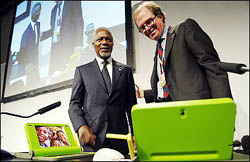 “Demo or die.” That was the creed of the MIT Media Lab in the glory days — days of ferment that produced important, foundational work in interactive media. Well, yesterday at the World Summit on the Information Society in Tunisia, where Nicholas Negroponte and Kofi Annan were unveiling the prototype of the 100 dollar laptop, the demo died. Or rather, the demo just didn’t happen.
As it turns out, Negroponte wasn’t able to get past the screen lock on the slick lime-green device, so the mob of assembled journalists and technofiles had to accept the 100 dollar gospel on faith, making do with touching anecdotes about destitute families huddled in wonder around their child’s new laptop, the brightest source of light in their tiny hovel. All told, an inauspicious beginning for the One Laptop Per Child intitiative, which aims to put millions of cheap, robust, free-software-chugging computers into the hands of the world’s poorest children.
Sorry to be so snide, but we were watching the live webcast from Tunis yesterday… it’s hard not to laugh at the leaders of the free world bumbling over this day-glo gadget, this glorified Trapper Keeper cum jack-in-the-box (Annan ended up breaking the hand crank), with barely a word devoted to what educational content will actually go inside, or to how teachers plan to construct lessons around these new toys. In the end, it’s going to come down to them. Good teachers, who know computers, may be able to put the laptops to good use. But somehow I’m getting visions of stacks of unused or busted laptops, cast aside like so many neon bricks.
A sunnier future for the 100 dollar laptop? A commercial company obtains the rights and starts selling them in the West for $250 a pop. They’re a huge hit. Everyone just has to have one to satisfy their poor inner child.
writing in the open
Mitch Stephens, NYU professor, was here for lunch today. when Ben and I met with him about a month ago about the academic bloggers/public intellectuals project, Mitch mentioned he had just signed a contract with Carroll & Graf to write a book on the history of atheism. today’s lunch was to follow up a suggestion we made that he might consider starting a blog to parallel the research and writing of the book. i’m delighted to report that Mitch has enthusiastically taken up the idea. sometime in the next few weeks we’ll launch a new blog, tentatively called Only Sky (shortened from the lyric of john lennon’s Imagine “. . . Above us only sky”). it will be an experiment to see whether blogging can be useful to the process of writing a book. i expect Mitch will be thinking out loud and asking all sorts of interesting questions. i also think that readers will likely provide important insight as well as ask their own fascinating questions which will in turn suggest fruitful directions of inquiry. stay tuned.
gawker blogs to appear on yahoo
Gawker Media, the Conde Nast of the blogosphere, has just sold distribution rights for five of its blogs to Yahoo. Selected posts from Gawker, Wonkette, Gizmodo, Lifehacker and Defamer will soon appear daily on the Yahoo news portal.
Not so worrisome (or surprising) to see blogs like these going corporate. From the beginning, they’ve sort of pitched themselves as commodities — the tabloids and gadget rags of the blogosphere. But when blogging comes fully front and center as the next hip business strategy — that authentic unfiltered element with which to adorn your comapany’s image (hang some humans on the doorpost) — then we may see a massive rush to rake up the brighter talents with lucrative little hosting deals. I’d hate to see bloggers foresake their independence like this. Then again, it might clear the way for a whole new generation of authentic voices.
all your base are belong to google
Google Base is live and ready for our stuff.
In AP: “New Project Will Expand Google’s Reach”
the book in the network – masses of metadata
In this weekend’s Boston Globe, David Weinberger delivers the metadata angle on Google Print:
…despite the present focus on who owns the digitized content of books, the more critical battle for readers will be over how we manage the information about that content-information that’s known technically as metadata.
…we’re going to need massive collections of metadata about each book. Some of this metadata will come from the publishers. But much of it will come from users who write reviews, add comments and annotations to the digital text, and draw connections between, for example, chapters in two different books.
As the digital revolution continues, and as we generate more and more ways of organizing and linking books-integrating information from publishers, libraries and, most radically, other readers-all this metadata will not only let us find books, it will provide the context within which we read them.
The book in the network is a barnacled spirit, carrying with it the sum of its various accretions. Each book is also its own library by virtue not only of what it links to itself, but of what its readers are linking to, of what its readers are reading. Each book is also a milk crate of earlier drafts. It carries its versions with it. A lot of weight for something physically weightless.
blog meeting in la-la land
The Chronicle of Higher Education has published a positive piece on blogging in academia, a first person account by Rebecca Goetz, one of the first academic bloggers, of how blogging can actually enhance scholarly life, foster trans-disciplinary communication, and connect the academy to the public sphere.
The timing of Goetz’s article is auspicious, as the institute is currently grappling with these very issues, gearing up for a grant proposal to do something big. Last week, about to dash out the door for the airport, I mentioned this project we’re cooking up to encourage, promote and organize academic blogging with the aim of raising its status as a scholarly activity. Well, last Friday in Los Angeles we assembled a cadre of over a dozen blog-oriented professors, grad students, and journalism profs, along with a radical blogger-librarian, a grassroots media producer, and a sociologist, for a day of stimulating discussion about what can happen when you put blogs in the hands of people who really know something about something.

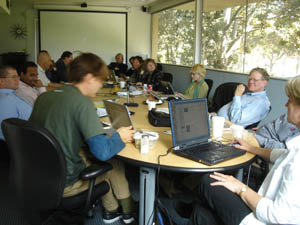
We’re still sifting through notes and thoughts from the meeting, and for anyone who’s interested we’ve devoted an entire blog to continuing the discussion. I guess you could say we’ve formed a little community dedicated to answering the big questions — chiefly, how the blogging medium might serve as a bridge between the world of scholarly knowledge and the world at large — and to helping us form the proposal for a project — a website? a network? a new sort of blog? — that will address some of these questions.
John Mohr, the afore-mentioned sociologist, described it as a matter of “marshaling and re-deploying intellectual capital,” which I think brilliantly and succinctly captures the possibilities of blogs both for making the academy more transparent and for helping it reach the general public, shining the light of knowledge, as it were, on the complexity of human affairs. The power of blogs is that they exist in a space all their own, not entirely within the academy and not (at least not yet) within the economic and editorial structures of mass media. Because of this, bloggers are able to maintain what McKenzie Wark calls “a slight angle of difference” from both sides. We here at the institute, from our not-quite-inside-not-quite-outside-the-academy vantage, are interested in simultaneously protecting that angle and boosting its stature.
Back in May, I saw Wark speak at a conference on new media education at CUNY called “Share, Share Widely.” He talked about how the academy should position itself in the media-saturated society and how it can employ new media tools (like blogging) to penetrate, and even redefine, the public sphere. I was mulling this over leading up to the meeting and it seems even more dead-on now:
“This tension between dialogue and discourse might not be unrelated to that between education and knowledge. Certainly what the new media technologies offer is a way of constructing new possibilities for the dialogic, ones which escape the boundaries of discipline, even of the university itself. New media is not interdisciplinary or transdisciplinary. It is antidisciplinary — although one might be careful where and to whom we break this news. Its acid with which to eat away at the ossified structure of discourse — with the aim of constructing a new structure of discourse. One that might bring closer together the university with its outside. Not to erase the precious interiority of the university, but to make it porous. To actually apply all that ‘theory’ we learned to our own institutions.”
“Imagine a political refugee, fleeing one country for another, jotting down his thoughts on the run, sharing them with his friends. I’m talking about Marx, writing the 1844 manuscripts. I think critical theory was always connected to new media practices. I think it was always about rethinking the discourse in which dialogue is possible. I think it was always knowledge escaping from the institutions of education. Think of Gramsci editing New Order, negotiating between metropolitan and subaltern languages. Think of Benjamin’s One Way Street, a pamphlet with bold typographic experiments. Or Brecht’s experiments in cinema. Or Debord’s last — amazing — TV program. Broadcast only once so you had to set your vcr. Or the Frankfurt School and Birmingham Schools, which broke down the intellectual division of labor. Or the autonomous studio Meilville built for Godard.”
“We need to do a ‘history of the present’ as Foucault would say, and recover the institutional aspect of knowledge as an object of critique. But of more than critique as well. Let’s not just talk about the ‘public sphere’. Let’s build some! We have the tools. We know wiki and blogging and podcasting. Let’s build new relations between theory and practice. No more theory without practice — but no more practice without theory either. Let’s work at slight angle of difference from the institution. Not against it — that won’t get you tenure — but not capitulating to it either. That won’t make any difference or be interesting to anybody.”