
Yearly Archives: 2005

alternative journalisms

Craigslist founder Craig Newmark has announced he will launch a major citizen journalism site within the next three months. As quoted in The Guardian:

The American public has lost a lot of trust in conventional newspaper mechanisms. Mechanisms are now being developed online to correct that.
…It was King Henry II who said: ‘Won’t someone rid me of that turbulent priest?’ We have seen a modern manifestation of that in the US with the instances of plausible deniability, the latest example of that has been the Valerie Plame case and that has caused damage.

Can a Craiglist approach work for Washington politics? It’s hard to imagine a million worker ants distributed across the nation cracking Plamegate. You’re more likely to get results from good old investigative reporting, but combined with a canny postmodern sense of spin (and we’re not just talking about the Bush administration’s spin, but Judith Miller’s spin, The New York Times’ spin) and the ability to make that part of the story. Combine the best of professional journalism with the best of the independent blogosphere. Can this be done?
Josh Marshall of Talking Points Memo fame wants to bridge the gap with a new breed of “reporter-blogger,” currently looking to fill two such positions — paid positions — for a new muckraking blog that will provide “wall-to-wall coverage of corruption, self-dealing, and betrayals of the public trust in today’s Washington” (NY Sun has details). While other high-profile bloggers sign deals with big media, Marshall clings fast to his independence, but recognizes the limitations of not being on the ground, in the muck, as it were. He’s banking that his new cyborgs might be able to shake up the stagnant Washington press corps from the inside, or at least offer readers a less compromised view (though perhaps down the road fledgeling media empires like Marshall’s will become the new media establishment).
2134_where_fema-vi.jpg That’s not to say that the Craigslist approach will not be interesting, and possibly important. It was dazzling to witness the grassroots information network that sprung up on the web during Hurricane Katrina, including on the Craigslist New Orleans site, which became a clearinghouse for news on missing persons and a housing directory for the displaced. For sprawling catastrophes like this it’s impossible to have enough people on the ground. Unless the people on the ground start reporting themselves.
Citizen journalists also pick up on small stories that slip through the cracks. You could say the guy who taped the Rodney King beating was a “citizen journalist.” You could say this video (taken surreptitiously on a cellphone) of a teacher in a New Jersey high school flipping out at a student for refusing to stand for the national anthem is “citizen journalism.” Some clips speak for themselves, but more often you need context, you need to know how to frame it. The interesting thing is how grassroots journalism can work with a different model for contextualization. The New Jersey video made the rounds on the web and soon became a story in the press. One person slaps up some footage and everyone else comments, re-blogs and links out. The story is told collectively.

the next dictionary

I found this Hartford Courant article on slashdot.
Martin Benjamin heads up an eleven year old project to create an online Swahili dictionary called the Kamusi Project. Despite 80 million speakers, the current Swahili dictionary is over 30 years old. Setting this project apart from other online dictionaries, these entries are created by, not only academics, but also by volunteers ranging from former Peace Corp workers to African linguistic hobbyists. The site also includes a discussion board for the community of users and developers.
It is also important to mention that, like wikipedia, donations and volunteers support this collaborative project. Unlike wikipedia, it does not have the broad audience and publicity that wikipedia enjoys, which makes funding a continual issue.

multimedia vs intermedia

Dick Higgins performing Danger Music No. 17
One of the odd things that strikes me about so much writing about technology is the seeming assumption that technology (and the ideas associated with it) arise from some sort of cultural vacuum. It’s an odd myopia, if not an intellectual arrogance, and it results in a widespream failure to notice many connections that should be obvious. One such connection is that between the work of many of the conceptual artists of the 1960s and continuing attempts to sort out what it means to read when books don’t need to be limited to text & illustrations. (This, of course, is a primary concern of the Institute.)

Lately I’ve been delving through the work of Dick Higgins (1938–1998), a self-described “polyartist” who might be most easily situated by declaring him to be a student of John Cage and part of the Fluxus group of artists. This doesn’t quite do him justice: Higgins’s work bounced back and forth between genres of the avant-garde, from music composition (in the rather frightening photo above, he’s performing his Danger Music No. 17, which instructs the performer to scream as loudly as possible for as long as possible) to visual poetry to street theatre. He supported himself by working as a printer: the first of several publishing ventures was the Something Else Press, which he ran from 1963 to 1974, publishing a variety of works by artists and poets as well as critical writing.

Click to see a larger version of Dick Higgins poetry intermedia poster“Betweenness” might be taken as the defining quality of his work, and this betweenness is what interests me. Higgins recognized this – he was perhaps as strong a critic as an artist – and in 1964, he coined the term “intermedia” to describe what he & his fellow Fluxus artists were doing: going between media, taking aspects from established forms to create new ones. An example of this might be visual, or concrete poetry, of which that of Jackson Mac Low or Ian Hamilton Finlay – both of whom Higgins published – might be taken as representative. Visual poetry exists as an intermediate form between poetry and graphic design, taking on aspects of both. This is elaborated (in an apposite form) in his poster on poetry & its intermedia; click on the thumbnail to the right to see a (much) larger version with legible type.

Higgins certainly did not imagine he was the first to use the idea of intermedia; he traced the word itself back to Samuel Taylor Coleridge, who had used it in the same sense in 1812. The concept has similarities to Richard Wagner’s idea of opera as Gesamkunstwerk, the “total artwork”, combining theatre and music. But Higgins suggested that the roots of the idea could be found in the sixteenth century, in Giordano Bruno’s On the Composition of Signs and Images, which he translated into English and annotated. And though it might be an old idea, a quote from a text about intermedia that he wrote in 1965 (available online at the always reliable Ubuweb) suggests parallels between the avant-garde world Higgins was working in forty years ago and our concern at the Institute, the way the book seems to be changing in the electronic world:

Much of the best work being produced today seems to fall between media. This is no accident. The concept of the separation between media arose in the Renaissance. The idea that a painting is made of paint on canvas or that a sculpture should not be painted seems characteristic of the kind of social thought–categorizing and dividing society into nobility with its various subdivisions, untitled gentry, artisans, serfs and landless workers–which we call the feudal conception of the Great Chain of Being. This essentially mechanistic approach continued to be relevant throughout the first two industrial revolutions, just concluded, and into the present era of automation, which constitutes, in fact, a third industrial revolution.

Higgins isn’t explicitly mentioning the print revolution started by Gutenberg or the corresponding changes in how reading is increasingly moving from the page to the screen, but that doesn’t seem like an enormous leap to make. A chart he made in 1995 diagrams the interactions between various sorts of intermedia:

higgins_intermedia_chart.gif

Note the question marks – Higgins knew there was terrain yet to be mapped out, and an interview suggests that he imagined that the genre-mixing facilitated by the computer might be able to fill in those spaces.

“Multimedia” is something that comes up all the time when we’re talking about what computers do to reading. The concept is simple: you take a book & you add pictures and sound clips and movies. To me it’s always suggested an assemblage of different kinds of media with a rubber band – the computer program or the webpage – around them, an assemblage that usually doesn’t work as a whole because the elements comprising it are too disparate. Higgins’s intermedia is a more appealing idea: something that falls in between forms is more likely to bear scrutiny as a unified object than a collection of objects. The simple equation text + pictures (the simplest and most common way we think about multimedia) is less interesting to me than a unified whole that falls between text and pictures. When you have text + pictures, it’s all too easy to criticize the text and pictures separately: this picture compared to all other possible pictures invariably suffered, just as this text compared to all other possible texts must suffer. Put in other terms, it’s a design failure.

A note added to the essay quoted above in 1981 more explicitly presents the ways in which intermedia can be a useful tool for approaching new work:

It is today, as it was in 1965, a useful way to approach some new work; one asks oneself, “what that I know does this new work lie between?” But it is more useful at the outset of a critical process than at the later stages of it. Perhaps I did not see that at the time, but it is clear to me now. Perhaps, in all the excitement of what was, for me, a discovery, I overvalued it. I do not wish to compensate with a second error of judgment and to undervalue it now. But it would seem that to proceed further in the understanding of any given work, one must look elsewhere–to all the aspects of a work and not just to its formal origins, and at the horizons which the work implies, to find an appropriate hermeneutic process for seeing the whole of the work in my own relation to it.

The last sentence bears no small relevance to new media criticism: while a video game might be kind of like a film or kind of like a book, it’s not simply the sum of its parts. This might be seen as the difference between thinking about terms of multimedia and in terms of intermedia. We might use it as a guideline for thinking about the book to come, which isn’t a simple replacement for the printed book, but a new form entirely. While we can think about the future book as incorporating existing pieces – text, film, pictures, sound – we will only really be able to appreciate these objects when we find a way to look at them as a whole.

An addendum: “Intermedia” got picked up as the name of a hypertext project out of Brown started in 1985 that Ted Nelson, among others, was involved with. It’s hard to tell whether it was thus named because of familiarity with Higgins’s work, but I suspect not: these two threads, the technologic and the artistic, seem to be running in parallel. But this isn’t necessarily, as is commonly suuposed, because the artists weren’t interested in technical possibilities. Higgins’s Book of Love & Death & War, published in 1972, might merit a chapter in the history of books & computers: a book-length aleatory poem, he notes in his preface that one of its cantos was composed with the help of a FORTRAN IV program that he wrote to randomize its lines. (Canto One of the poem is online at Ubuweb; this is not, however, the computer-generated part of the work.)

And another addendum: something else to take from Higgins might be his resistance to commodification. Because his work fell between the crevices of recognized forms, it couldn’t easily be marketed: how would you go about selling his metadramas, for example? It does, however, appear perfectly suited for the web & perhaps this resistance to commodification is apropos right now, in the midst of furious debates about whether information wants to be free or not. “The word,” notes Higgins in one of his Aphorisms for a Rainy Day in the poster above, “is not dead, it is merely changing its skin.”


explosion

250px-Nuclear_fireball.jpg A Nov. 18 post on Adam Green’s Darwinian Web makes the claim that the web will “explode” (does he mean implode?) over the next year. According to Green, RSS feeds will render many websites obsolete:
The explosion I am talking about is the shifting of a website’s content from internal to external. Instead of a website being a “place” where data “is” and other sites “point” to, a website will be a source of data that is in many external databases, including Google. Why “go” to a website when all of its content has already been absorbed and remixed into the collective datastream.
Does anyone agree with Green? Will feeds bring about the restructuring of “the way content is distributed, valued and consumed?” More on this here.

the evils of photoshop?

napalm8pl.jpg
In a larger essay which bemoans the rise of image culture, Christine Rosen goes after Photoshop and its users in The New Atlantis, a right-leaning journal concerned with the intersection of technology and cultural values. According to Rosen, the software “democratizes the ability to commit fraud,” corrupting its users by giving them easy access to the tools of reality manipulation. She writes:
Photoshop has introduced a new fecklessness into our relationship with the image. We tend to lose respect for things we can manipulate. And when we can so readily manipulate images–even images of presidents or loved ones–we contribute to the decline of respect for what the image represents…
Worrying about photographic fakery isn’t new, of course — as Rosen herself notes, Susan Sontag inveighed against manipulated images in her 1977 work On Photography, and Rosen takes her point that images have been manipulated prior to the age of digitization. Here, however, Rosen’s concern with digital manipulation focuses less on the ability of people to deceive others with altered photos than on the ability of Photoshop to propel its users towards a general irreverence towards the real. This is an interesting inversion of the point that Bob Stein makes in a recent post; namely, that we have less respect for digitally manipulated images than ones which are “real.”
Later in the essay, Rosen suggests that some Photoshop images can be seen as the equivalent of today’s carnival sideshow:
“Photoshop contests” such as those found on the website Fark.com offer people the opportunity to create wacky and fantastic images that are then judged by others in cyberspace. This is an impulse that predates software and whose most enthusiastic American purveyor was, perhaps, P. T. Barnum. In the nineteenth century, Barnum barkered an infamous “mermaid woman” that was actually the moldering head of a monkey stitched onto the body of a fish. Photoshop allows us to employ pixels rather than taxidermy to achieve such fantasies, but the motivation for creating them is the same–they are a form of wish fulfillment and, at times, a vehicle for reinforcing our existing prejudices.
Looking at the Photoshop image above (which I pulled from the first Fark photoshop contest I came across), I can see the root of Rosen’s indignation: there is something offensive about the photo’s casual attitude toward an iconic image. But having seen similarly offensive editorial cartoons that riff on iconic phototographs, I’m not persuaded that Photoshop is the issue. It is true that without Photoshop this image would not have been made; indeed, as Rosen suggests, there is a Photoshop subculture on Fark that promotes the creation of absurd and often offensive images. But can we really make the argument that those who create these images become, in the process, less respectful of the reality they represent? I tend to resist such technological determinism: I would argue, against Rosen, that people manipulate images because they are already irreverent towards them — or, alternately, because they are cynical about the ability of images to represent truth.

world digital library

library of congress.jpg The Library of Congress has announced plans for the creation of a World Digital Library, “a shared global undertaking” that will make a major chunk of its collection freely available online, along with contributions from other national libraries around the world. From The Washington Post:
…[the] goal is to bring together materials from the United States and Europe with precious items from Islamic nations stretching from Indonesia through Central and West Africa, as well as important materials from collections in East and South Asia.

Google has stepped forward as the first corporate donor, pledging $3 million to help get operations underway. At this point, there doesn’t appear to be any direct connection to Google’s Book Search program, though Google has been working with LOC to test and refine its book-scanning technology.

hmmm… online word processing

Not quite sure what I think of this new web-based word processor, Writely. Cute Web 2.0ish name, “beta” to the hilt. It’s free and quite easy to get started. I guess it falls into that weird zone of transitional unease between desktop computing and the wide open web, where more and more of our identity and information resides. Some of the tech specifics: Writely saves documents in Word and (as of today) Open Office formats, outputs as RSS and to some blogging platforms (not ours), and can also be saved as a simple web page (here’s the Writely version of this post). A key feature is that Writely documents can be written and edited by multiple authors, like SubEthaEdit only totally net-based. It feels more or less like a disembodied text editor for a wiki.
I’m trying to think about what’s different about writing online. Movable Type, our blogging software, is essentially an ultra-stripped-down text editor — web-based — and it’s no fun to work in. That’s partly because the text field is about the size of a mail slot, but writing online can be annoying for other reasons, chief among them the fact that you have to be online to work, and second that you are susceptible to the chance mishaps of the browser (accidentally backing up and losing everything, it crashes, you forgot to pay Time Warner and they turn off the web etc.). But with a conventional word processor you’re vulnerable to the mishaps of the machine (hard drive dies and you didn’t back it up, it crashes and you didn’t save, coffee spills…). Writely saves everything automatically as you go, maintaining a revision history and tracking changes — a very nice feature.
They say this is the future of software, at least for the simple everyday kind of stuff: web-based tool suites and tons of online data storage. I guess it’s nice not having to be tied to one machine. Your work is just out there, waiting for you to log in. But then again, your work is just out there…

beautiful? if so, why?

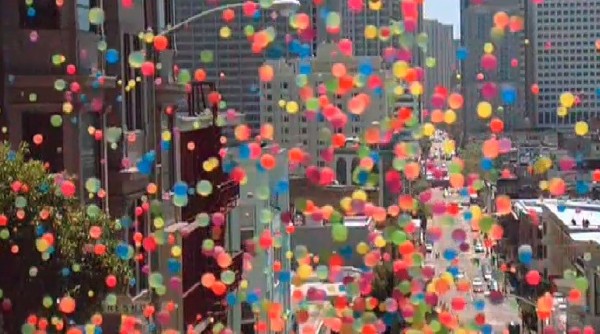
Sony Europe is promoting a new screen technology with a TV commercial featuring 250,000 brightly colored balls rolling down a San Francisco street. despite the maudlin soundtrack the sight of a quarter of a million balls floating chaotically down the hill is spectacular. this is partially because the piece is silly, fantastical, and brilliantly executed. i wonder though, if part of the reason people like the ad so much is because real balls are rolling on a real street — because the absence of any computer graphics is so unusual in our increasingly everything-so-neat-and-clean digital mediascape? this is not meant to be a rhetorical question. what do you think?
sony_brevia.jpg

“open source media” — not the radio show — launches a best-bloggers site

On Wednesday, November 17, a media corporation called Open Source Media launched a portal site that intends to assemble the best bloggers on the internet in one place. According to the Associated Press, some 70 Web journalists, including Instapundit’s Glenn Reynolds and David Corn, Washington editor of the Nation magazine, have agreed to participate. The site will link to individual blog postings and highlight the best contributions in a special section: bloggers will be paid for content depending on the amount of traffic they generate.
Far from a seat-of-the-pants effort, OSM has $3.5 million dollars in venture capital funding. Supposedly, the site will pay for itself — and pay its bloggers — with the advertising it generates. In the “about” section of the site, the founders of OSM lay out their vision for remaking the future of blogging and media in general:
OSM’s mission is to expand the influence of weblogs by finding and promoting the best of them, providing bloggers with a forum to meet and share resources, and the chance to join a for-profit network that will give them additional leverage to pursue knowledge wherever they may find it. From academics, professionals and decorated experts, to ordinary citizens sitting around the house opining in their pajamas, our community of bloggers are among the most widely read and influential citizen journalists out there, and our roster will be expanding daily. We also plan to provide a bridge between old media and new, bringing bloggers and mainstream journalists–more and more of whom have started to blog–together in a debate-friendly forum.
We at if:book like the idea of a blog portal, especially one staffed by a series of editors selecting the best posts on the blogs they’ve chosen. But this venture — which fits perfectly with John Batelle’s vision for the web’s second coming — also seems to nicely embody the tension between doing good and making money: all that venture capital and overhead is going to put a lot of pressure on OSM to deliver the Oprah of the blogging world, if she’s out there. And paying bloggers based on how many readers they get is certainly going to shape the content that appears on the site. Unlike others who conceived of their blogs from the get-go as small businesses, most of the bloggers chosen by OSM haven’t been trying to make money from their blogs until now.
OSM also shot themselves in the foot by stealing the name of the newish public radio show Open Source Media, which we’ve written about here. The two are currently involved in a dispute over the name. and OSM hasn’t really been able to come up with a good reason why they should keep using a name that belongs to someone else. They have trademarked OSM, and they now refer to their unabbreviated name as “not a trade name,” but “a description of who we are and what we do.”
Needless to say, OSM has generated a fair amount of bad blood by appropriating the name of a nonprofit, and most of the grumbling has taken place in exactly the same place OSM hopes to make a difference — the blogosphere.