
Becky Hogge writes in Opendemocracy about a new digital rights organization, The Open Rights Group, based in Westminster, Brussels and Geneva. Like the Electronic Frontier Foundation in the United States, the Open Rights Group will address issues such as access, freedom of speech online, and file sharing. Unlike the EFF — which was initially bankrolled by a small group of beleivers — the Open Rights Group was started by a group of 1,000 subscribers who will each pay five pounds a month to get the organization going.
Yearly Archives: 2005
katrina archive on internet archive
The Internet Archive has just established an archive dedicated to preserving the online response to the Katrina catastrophe. According to the Archive:
The Internet Archive and many individual contributors worked together to put together a comprehensive list of websites to create a historical record of the devastation caused by Hurricane Katrina and the massive relief effort which followed. This collection has over 25 million unique pages, all text searchable, from over 1500 sites. The web archive commenced on September 4th.
If you try to link to the Internet Archive today, you might not get through, because everyone is on the site talking about the Grateful Dead’s decision to allow free downloading
freedom forum founder wants less freedom online
For just over four months, a biography of Freedom Forum Founder John Seigenthaler that appeared on Wikipedia, Biography.com, and Answers.com claimed — incorrectly — that he was once a suspect in the assasination of both John and Robert Kennedy. Last month, Seigenthaler found out about it, and he got angry. Very angry.
In fact, he got angry enough to write a November 29 editorial in USA Today complaining about Federal laws that protect online corporations like Wikiepedia from libel lawsuits and protect the anonymity of the person who published false information about him online.
Don’t get me wrong: it’s certainly a serious problem that Seigenthaler’s biography contained false information (I haven’t been able to determine yet whether the assassination rumor is an artifact of the vast Kennedy conspiracy rumor mill, or whether it was a pure invention of the phony biographer — anyone know?). And the flaws in Wikipedia are a real issue. But I’m still astonished that one of the nation’s great free speech advocates seems to be advocating systemic changes to legislation that protects not only prank speech, but political speech online.
Is it that Seigenthaler feels (but does not say) that there is a fundamental difference between print media and online? Or is this a case of someone knowing Seigenthaler’s Achille’s heel, and publishing the one rumor about him that would cause him to seemingly contradict his basic principles?
google print on deck at radio open source
Open Source, the excellent public radio program (not to be confused with “Open Source Media”) that taps into the blogosphere to generate its shows, has been chatting with me about putting together an hour on the Google library project. Open Source is a unique hybrid, drawing on the best qualities of the blogosphere — community, transparency, collective wisdom — to produce an otherwise traditional program of smart talk radio. As host Christopher Lydon puts it, the show is “fused at the brain stem with the world wide web.” Or better, it “uses the internet to be a show about the world.”
The Google show is set to air live this evening at 7pm (ET) (they also podcast). It’s been fun working with them behind the scenes, trying to figure out the right guests and questions for the ideal discussion on Google and its bookish ambitions. My exchange has been with Brendan Greeley, the Radio Open Source “blogger-in-chief” (he’s kindly linked to us today on their site). We agreed that the show should avoid getting mired in the usual copyright-focused news peg — publishers vs. Google etc. — and focus instead on the bigger questions. At my suggestion, they’ve invited Siva Vaidhyanathan, who wrote the wonderful piece in the Chronicle of Higher Ed. that I talked about yesterday (see bigger questions). I’ve also recommended our favorite blogger-librarian, Karen Schneider (who has appeared on the show before), science historian George Dyson, who recently wrote a fascinating essay on Google and artificial intelligence, and a bunch of cybertext studies people: Matthew G. Kirschenbaum, N. Katherine Hayles, Jerome McGann and Johanna Drucker. If all goes well, this could end up being a very interesting hour of discussion. Stay tuned.
UPDATE: Open Source just got a hold of Nicholas Kristof to do an hour this evening on Genocide in Sudan, so the Google piece will be pushed to next week.
chicago tribune on e-lit
A November 27 Chicago Tribune article by Julia Keller bundles together hypertext fiction, blogging, texting, and new electronic distribution methods for books under a discussion of “e-literature.” Interviewing Scott Rettberg (of Grand Text Auto) and MIT’s William J. Mitchell, the reporter argues that the hallmark of e-literature is increased consumer control over the shape and content of a book:
Literature, like all genres, is being reimagined and remade by the constantly unfolding extravagance of technological advances. The question of who’s in charge — the producer or the consumer — is increasingly relevant to the literary world. The idea of the book as an inert entity is gradually giving way to the idea of the book as a fluid, formless repository for an ever-changing variety of words and ideas by a constantly modified cast of writers.
A fluid, formless repository? Ever-changing words? This is the Ipod version of the future of literature, and I’m having a hard time articulating why I find it disturbing. It might be the idea that the digitized literature will bring about a sort of consumer revolution. I can’t help but think of this idea as a strange rearticulation of the Marxist rhetoric of the Language Poets, a group of experimental writers who claimed to give the reader a greater role in the production process of a literary work as part of critique of capitalism (more on this here). In the Ipod model of e-literature, readers don’t challenge the capitalist sytem: they are consumers, empowered by their purchasing power.
There’s also a a contradiction in the article itself: Keller’s evolutionary narrative, in which the “inert book” slowly becomes an obsolete concept, is undermined by her last paragraphs. She ends the article by quoting Mitchell, who insists that there will always be a place for “traditional paper-based literature” because a book “feels good, looks good — it really works.” This gets us back to Malcolm Gladwell territory: is it true that paper books will always seem to work better than digital ones? Or is it just too difficult to think beyond what “feels good” right now?
sober thoughts on google: privatization and privacy
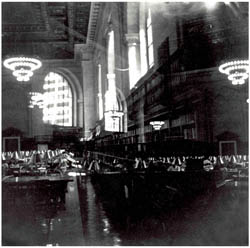
Siva Vaidhyanathan has written an excellent essay for the Chronicle of Higher Education on the “risky gamble” of Google’s book-scanning project — some of the most measured, carefully considered comments I’ve yet seen on the issue. His concerns are not so much for the authors and publishers that have filed suit (on the contrary, he believes they are likely to benefit from Google’s service), but for the general public and the future of libraries. Outsourcing to a private company the vital task of digitizing collections may prove to have been a grave mistake on the part of Google’s partner libraries. Siva:
The long-term risk of privatization is simple: Companies change and fail. Libraries and universities last…..Libraries should not be relinquishing their core duties to private corporations for the sake of expediency. Whichever side wins in court, we as a culture have lost sight of the ways that human beings, archives, indexes, and institutions interact to generate, preserve, revise, and distribute knowledge. We have become obsessed with seeing everything in the universe as “information” to be linked and ranked. We have focused on quantity and convenience at the expense of the richness and serendipity of the full library experience. We are making a tremendous mistake.
This essay contains in abundance what has largely been missing from the Google books debate: intellectual courage. Vaidhyanathan, an intellectual property scholar and “avowed open-source, open-access advocate,” easily could have gone the predictable route of scolding the copyright conservatives and spreading the Google gospel. But he manages to see the big picture beyond the intellectual property concerns. This is not just about economics, it’s about knowledge and the public interest.
What irks me about the usual debate is that it forces you into a position of either resisting Google or being its apologist. But this fails to get at the real bind we all are in: the fact that Google provides invaluable services and yet is amassing too much power; that a private company is creating a monopoly on public information services. Sooner or later, there is bound to be a conflict of interest. That is where we, the Google-addicted public, are caught. It’s more complicated than hip versus square, or good versus evil.
Here’s another good piece on Google. On Monday, The New York Times ran an editorial by Adam Cohen that nicely lays out the privacy concerns:
Google says it needs the data it keeps to improve its technology, but it is doubtful it needs so much personally identifiable information. Of course, this sort of data is enormously valuable for marketing. The whole idea of “Don’t be evil,” though, is resisting lucrative business opportunities when they are wrong. Google should develop an overarching privacy theory that is as bold as its mission to make the world’s information accessible – one that can become a model for the online world. Google is not necessarily worse than other Internet companies when it comes to privacy. But it should be doing better.
Two graduate students in Stanford in the mid-90s recognized that search engines would the most important tools for dealing with the incredible flood of information that was then beginning to swell, so they started indexing web pages and working on algorithms. But as the company has grown, Google’s admirable-sounding mission statement — “to organize the world’s information and make it universally accessible and useful” — has become its manifest destiny, and “information” can now encompass the most private of territories.
At one point it simply meant search results — the answers to our questions. But now it’s the questions as well. Google is keeping a meticulous record of our clickstreams, piecing together an enormous database of queries, refining its search algorithms and, some say, even building a massive artificial brain (more on that later). What else might they do with all this personal information? To date, all of Google’s services are free, but there may be a hidden cost.
“Don’t be evil” may be the company motto, but with its IPO earlier this year, Google adopted a new ideology: they are now a public corporation. If web advertising (their sole source of revenue) levels off, then investors currently high on $400+ shares will start clamoring for Google to maintain profits. “Don’t be evil to us!” they will cry. And what will Google do then?
images: New York Public Library reading room by Kalloosh via Flickr; archive of the original Google page
flushing the net down the tubes
Grand theories about upheavals on the internet horizon are in ready supply. Singularities are near. Explosions can be expected in the next six to eight months. Or the whole thing might just get “flushed” down the tubes. This last scenario is described at length in a recent essay in Linux Journal by Doc Searls, which predicts the imminent hijacking of the net by phone and cable companies who will turn it into a top-down, one-way broadcast medium. In other words, the net’s utopian moment, the “read/write” web, may be about to end. Reading Searls’ piece, I couldn’t help thinking about the story of radio and a wonderful essay Brecht wrote on the subject in 1932:

Here is a positive suggestion: change this apparatus over from distribution to communication. The radio would be the finest possible communication apparatus in public life, a vast network of pipes. That is to say, it would be if it knew how to receive as well as to transmit, how to let the listener speak as well as hear, how to bring him into a relationship instead of isolating him. On this principle the radio should step out of the supply business and organize its listeners as suppliers….turning the audience not only into pupils but into teachers.
Unless you’re the military, law enforcement, or a short-wave hobbyist, two-way radio never happened. On the mainstream commercial front, radio has always been about broadcast: a one-way funnel. The big FM tower to the many receivers, “prettifying public life,” as Brecht puts it. Radio as an agitation? As an invitation to a debate, rousing families from the dinner table into a critical encounter with their world? Well, that would have been neat.
Now there’s the internet, a two-way, every-which-way medium — a stage of stages — that would have positively staggered a provocateur like Brecht. But although the net may be a virtual place, it’s built on some pretty actual stuff. Copper wire, fiber optic cable, trunks, routers, packets — “the vast network of pipes.” The pipes are owned by the phone and cable companies — the broadband providers — and these guys expect a big return (far bigger than they’re getting now) on the billions they’ve invested in laying down the plumbing. Searls:
The choke points are in the pipes, the permission is coming from the lawmakers and regulators, and the choking will be done….The carriers are going to lobby for the laws and regulations they need, and they’re going to do the deals they need to do. The new system will be theirs, not ours….The new carrier-based Net will work in the same asymmetrical few-to-many, top-down pyramidal way made familiar by TV, radio, newspapers, books, magazines and other Industrial Age media now being sucked into Information Age pipes. Movement still will go from producers to consumers, just like it always did.
If Brecht were around today I’m sure he would have already written (or blogged) to this effect, no doubt reciting the sad fate of radio as a cautionary tale. Watch the pipes, he would say. If companies talk about “broad” as in “broadband,” make sure they’re talking about both ends of the pipe. The way broadband works today, the pipe running into your house dwarfs the one running out. That means more download and less upload, and it’s paving the way for a content delivery platform every bit as powerful as cable on an infinitely broader band. Data storage, domain hosting — anything you put up there — will be increasingly costly, though there will likely remain plenty of chat space and web mail provided for free, anything that allows consumers to fire their enthusiasm for commodities through the synapse chain.
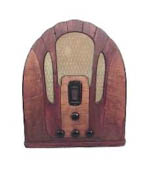 If the net goes the way of radio, that will be the difference (allow me to indulge in a little dystopia). Imagine a classic Philco cathedral radio but with a few little funnel-ended hoses extending from the side that connect you to other listeners. “Tune into this frequency!” “You gotta hear this!” You whisper recommendations through the tube. It’s sending a link. Viral marketing. Yes, the net will remain two-way to the extent that it helps fuel the market. Web browsers, like the old Philco, would essentially be receivers, enabling participation only to the extent that it encouraged others to receive.
You might even get your blog hosted for free if you promote products — a sports shoe with gelatinous heels or a music video that allows you to undress the dancing girls with your mouse. Throw in some political rants in between to blow off some steam, no problem. That’s entrepreneurial consumerism. Make a living out of your appetites and your ability to make them infectious. Hip recommenders can build a cosy little livelihood out of their endorsements. But any non-consumer activity will be more like amateur short-wave radio: a mildly eccentric (and expensive) hobby (and they’ll even make a saccharine movie about a guy communing with his dead firefighter dad through a ghost blog).
Searls sees it as above all a war of language and metaphor. The phone and cable companies will dominate as long as the internet is understood fundamentally as a network of pipes, a kind of information transport system. This places the carriers at the top of the hierarchy — the highway authority setting the rules of the road and collecting the tolls. So far the carriers have managed, through various regulatory wrangling and court rulings, to ensure that the “transport metaphor” has prevailed.
But obviously the net is much more than the sum of its pipes. It’s a public square. It’s a community center. It’s a market. And it’s the biggest publishing system the world has ever known. Searls wants to promote “place metaphors” like these. Sure, unless you’re a lobbyist for Verizon or SBC, you probably already think of it this way. But in the end it’s the lobbyists that will make all the difference. Unless, that is, an enlightened citizens’ lobby begins making some noise. So a broad, broad as in broadband, public conversation should be in order. Far broader than what goes on in the usual progressive online feedback loops — the Linux and open source communities, the creative commies, and the techno-hip blogosphere, that I’m sure are already in agreement about this.
Google also seems to have an eye on the pipes, reportedly having bought thousands of miles of “dark fiber” — pipe that has been laid but is not yet in use. Some predict a nationwide “Googlenet.” But this can of worms is best saved for another post.
virtual libraries, real ones, empires
 Last Tuesday, a Washington Post editorial written by Library of Congress librarian James Billington outlined the possible benefits of a World Digital Library, a proposed LOC endeavor discussed last week in a post by Ben Vershbow. Billington seemed to imagine the library as sort of a United Nations of information: claiming that “deep conflict between cultures is fired up rather than cooled down by this revolution in communications,” he argued that a US-sponsored, globally inclusive digital library could serve to promote harmony over conflict:
Libraries are inherently islands of freedom and antidotes to fanaticism. They are temples of pluralism where books that contradict one another stand peacefully side by side just as intellectual antagonists work peacefully next to each other in reading rooms. It is legitimate and in our nation’s interest that the new technology be used internationally, both by the private sector to promote economic enterprise and by the public sector to promote democratic institutions. But it is also necessary that America have a more inclusive foreign cultural policy — and not just to blunt charges that we are insensitive cultural imperialists. We have an opportunity and an obligation to form a private-public partnership to use this new technology to celebrate the cultural variety of the world.
What’s interesting about this quote (among other things) is that Billington seems to be suggesting that a World Digital Library would function in much the same manner as a real-world library, and yet he’s also arguing for the importance of actual physical proximity. He writes, after all, about books literally, not virtually, touching each other, and about researchers meeting up in a shared reading room. There seems to be a tension here, in other words, between Billington’s embrace of the idea of a world digital library, and a real anxiety about what a “library” becomes when it goes online.
I also feel like there’s some tension here — in Billington’s editorial and in the whole World Digital Library project — between “inclusiveness” and “imperialism.” Granted, if the United States provides Brazilians access to their own national literature online, this might be used by some as an argument against the idea that we are “insensitive cultural imperialists.” But there are many varieties of empire: indeed, as many have noted, the sun stopped setting on Google’s empire a while ago.
To be clear, I’m not attacking the idea of the World Digital Library. Having watch the Smithsonian invest in, and waffle on, some of their digital projects, I’m all for a sustained commitment to putting more material online. But there needs to be some careful consideration of the differences between online libraries and virtual ones — as well as a bit more discussion of just what a privately-funded digital library might eventually morph into.
gaming and the academy
So, what happens when you put together a drama professor and a computer science one?
You get an entertainment technology program. In an article, in the NY Times, Seth Schiesel talks about the blossoming of academic programs devoted entirely to the study and development of video games, offering courses that range from basic game programming to contemporary culture studies.
Since first appearing about three decades ago, video games are well on their way to becoming the dominant medium of the 21st century. They are played across the world by people of all ages, from all walks of life. And in a time where everything is measured by the bottom line, they have in fact surpassed the movie industry in sales. The academy, therefore, no matter how conservative, cannot continue to ignore this phenomenon for long. So from The New School (which includes Parsons) to Carnegie Mellon, prestigious colleges and universities are beginning to offer programs in interactive media. In the last five years the number of universities offering game-related programs has gone from a mere handful to more than 100. This can hardly be described as widescale penetration of higher education, but the trend is unmistakable.
The video game industry has a stake in advancing these programs since they stand to benefit from a pool of smart, sophisticated young developers ready upon graduation to work on commercial games. Bing Gordon, CEO of Electronic Arts says that there is an over-production of cinema studies professionals but that the game industry still lacks the abundant in-flow of talent that the film industry enjoys. Considering the state of public education in this country, it seems that video game programs will continue flourishing only with the help of private funds.
The academy offers the possibility for multidisciplinary study to enrich students’ technical and academic backgrounds, and to produce well-rounded talents for the professional world. In his article, Schiesel quotes Bing Gordon:
To create a video game project you need the art department and the computer science department and the design department and the literature or film department all contributing team members. And then there needs to be a leadership or faculty that can evaluate the work from the individual contributors but also evaluate the whole project.
These collaborations are possible now, in part, because technology has become an integral part of art production in the 21st century. It’s no longer just for geeks. The contributions of new media artists are too prominent and sophisticated to be ignored. Therefore it seems quite natural that, for instance, an art department might collaborate with faculty in computer science.
war on text?

Last week, there was a heated discussion on the 1600-member Yahoo Groups videoblogging list about the idea of a videobloggers launching a “war on text” — not necessarily calling for book burning, but at least promoting the use of threaded video conversations as a way of replacing text-based communication online. It began with a post to the list by Steve Watkins and led to responses such as this enthusiastic embrace of the end of using text to communicate ideas:
Audio and video are a more natural medium than text for most humans. The only reason why net content is mainly text is that it’s easier for programs to work with — audio and video are opaque as far as programs are concerned. On top of that, it’s a lot easier to treat text as hypertext, and hypertext has a viral quality.
As a text-based attack on the printed work, the “war on text” debate had a Phaedrus aura about it, especially since the vloggers seemed to be gravitating towards the idea of secondary orality originally proposed by Walter Ong in Orality and Literacy — a form of communication which is involved at least the representation of an oral exchange, but which also draws on a world defined by textual literacy. The vlogger’s debt to the written word was more explicitly acknowledged some posts, such as one by Steve Garfield that declared his work to be a “marriage of text and video.”
Over several days, the discussion veered to cover topics such as film editing, the over-mediation of existence, and the transition from analog to digital. The sophistication and passion of the discussion gave a sense of the way at least some in the video blogging community are thinking, both about the relationship between their work and text-based blogging and about the larger relationship between the written word and other forms of digitally mediated communication.
Perhaps the most radical suggestion in the entire exchange was the prediction that video itself would soon seem to be an outmoded form of communication:
in my opinion, before video will replace text, something will replace video…new technologies have already been developed that are more likely to play a large role in communications over this century… how about the one that can directly interface to the brain (new scientist reports on electroencephalography with quadriplegics able to make a wheelchair move forward, left or right)… considering the full implications of devices like this, it’s not hard to see where the real revolutions will occur in communications.
This comment implies that debates such as the “war on text” are missing the point — other forms of mediation are on the horizon that will radically change our understanding of what “communication” entails, and make the distinction between orality and literacy seem relatively miniscule. It’s an apocalyptic idea (like the idea that the internet will explode), but perhaps one worth talking about.